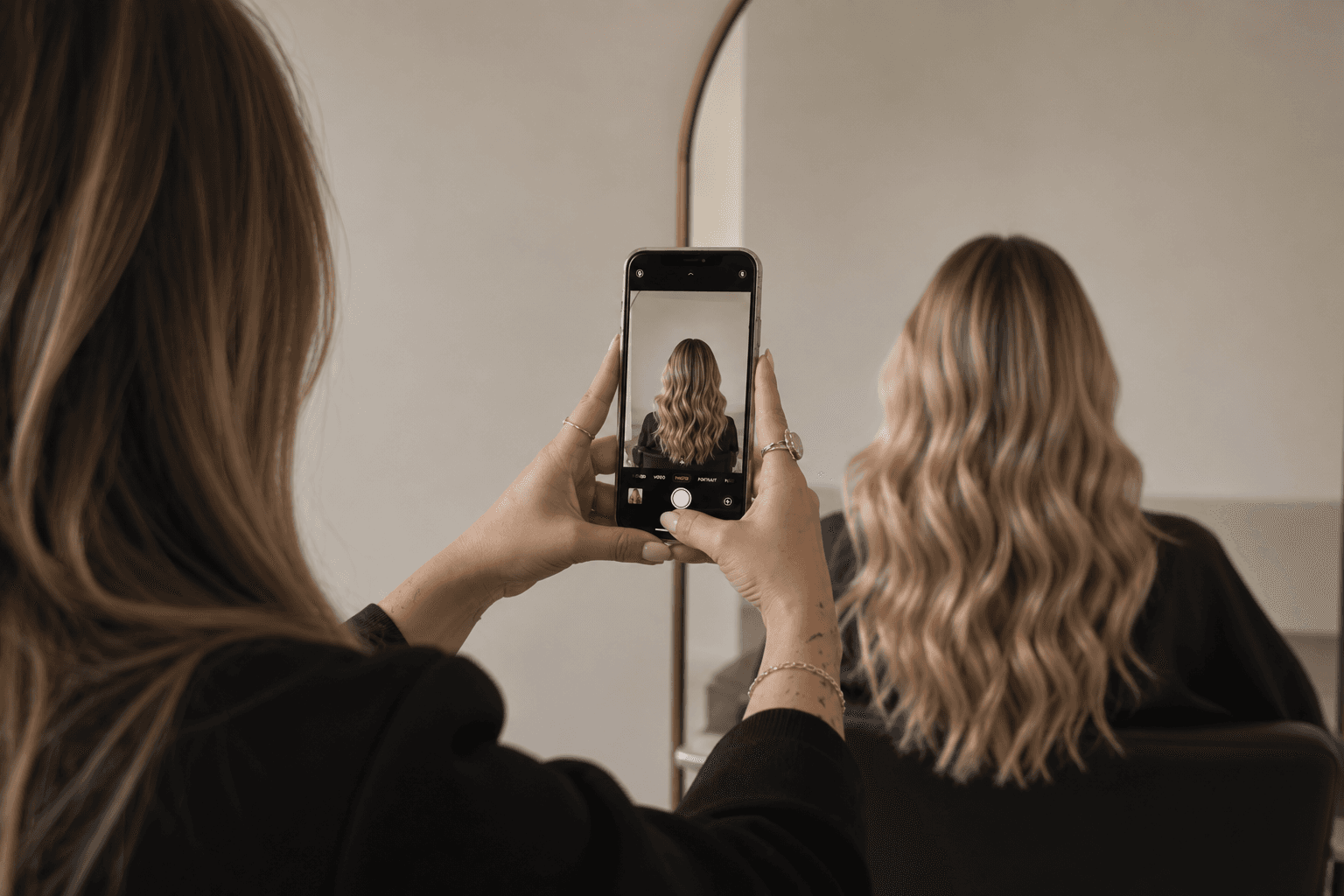
I teach Instagram growth for a living. I've built my entire business on social media, I've helped thousands of people grow theirs, and I'll defend the platform to anyone who calls it a waste of time.
If you're wondering how to use social media with your website, instead of picking one and hoping it's enough, this is the piece nobody explains clearly. Social gets people to notice you. A website gets them to choose you. When they work together, you stop losing clients in the gap between the two.

Discovery and conversion are two different jobs
Instagram and TikTok are extraordinary at discovery. Someone is lying in bed at 11pm, they see your before-and-after, your finished room, your plated dish, whatever your version of the money shot is, and they stop scrolling. They feel something. That's the algorithm doing exactly what you want.
And the data backs it up. Sprout Social found that 41% of Gen Z now turn to social platforms first when they're looking something up, ahead of traditional search engines at 32%. Across all age groups, 76% of people say social content influenced a purchase in the last six months.
So yes. Social is where you get found.
But the question I get more than any other is some version of: I'm posting constantly, why is nothing happening? And nine times out of ten it isn't a content problem. The content is working fine. It's just landing nowhere.
Getting found and getting booked are two separate moments, and they need two different tools.
Think about it: the same person who saved your reel at 11pm wakes up the next morning and does something very unromantic. They go looking for proof: reviews, prices, past work. BrightLocal's 2026 survey found that 97% of consumers read reviews for local businesses, and once those reviews check out, 54% go on to visit the business's website, up sharply from 32% in 2019.
Your feed made them curious. Something else has to make them confident.
What breaks when social media is your only home base
None of these are dramatic. That's exactly why they're so easy to miss. You don't feel the client you lost, because you never knew they were there.
Your DMs become a filing system that eats itself
A serious question about your pricing lands at 9:14am. Two "hey! love your stuff 🙌" messages land at 9:16am. By lunch, the real inquiry is buried under a collab request, two spam links, and someone asking if you're hiring.
Some of the busiest people I work with have huge, healthy followings and still lose work every single week, not because nobody asked, but because the one message that mattered arrived between a spam link and a collab request. It's not a discipline problem. Your inbox is just not a booking system, and it never claimed to be.
You answer the same five questions forever
What do you charge? Do you take card? Do you travel? How far out are you booked? What's included?
Every one of those answers costs you a few minutes of typing you'll never get back. Multiply by every inquiry, every week, all year. That's not customer service, that's an unpaid job you've quietly given yourself.
Your best work is scattered across two years of grid posts
There's one project you're genuinely proud of. It's some of the best work you've ever done. It's also from March 2024, and it's now sitting behind 180 posts, a giveaway, and a video of your dog.
Someone trying to find out whether you handle their specific kind of job is not going to scroll for it. They'll assume you don't do it.
There's no single place that says what you do and what it costs
Your services live in a link-in-bio, a highlight reel, a pinned comment, and your own head. Ask five past clients what you charge for your most popular service and you may get five different answers.
Search can't see you
This one is the quiet one. Instagram is a walled garden, the work you post there doesn't help anyone find you outside the app.
Meanwhile BrightLocal found Google is still the #1 place people go for local recommendations at 71%, and here's the number that genuinely surprised me: 45% of consumers now use ChatGPT or AI tools to find local businesses, up from just 6% a year ago.
Those searches are happening about your city, your service, your price range, right now. If everything you've built lives inside one app, you're invisible in every one of them.
What clients actually want before they book
When someone is deciding whether to hand you their money, and usually something they care about a lot more than the money, they're running a quiet checklist. Whatever you do for a living, it's almost always the same five things:
- Is this person real and still working? (A live site with recent work says yes in about two seconds.)
- What exactly do you do, and what does it cost?
- Have you done my thing before? Not your best work, their exact situation, budget, and timeline.
- How do I book, and how fast will you reply?
- Where are you, and can I get there?
Look at that list again. Not one of those is answered well by a feed. All five are answered instantly by one page.
How to use social media with your website: the two-job rule
Here's the framework I give everyone, and it's not complicated.
Social media's job: earn attention. Reels, stories, trends, personality, behind-the-scenes, the mess and the magic. Keep doing all of it. This is where you're already excellent.
Your website's job: earn the booking. Services, pricing, a real portfolio organized by the kind of work you do, availability, location, FAQs, and a booking or enquiry link that works at 11pm while you're asleep.
Then you connect them, and it takes about four minutes:
- Put your site in your bio - one link, not a maze of options.
- "Full pricing on my site" beats "DM me for prices," every time. One sends them to an answer; the other sends them to your to-do list.
- Add it to your story highlights so it's findable without scrolling.
- Let your site absorb the repeat questions. Write the five answers once. Send the link forever.
- Keep your best work in both places. Post it on social for reach; file it on your site so it's findable in a year.
That's it. Social feeds the site. The site closes the loop. Nothing you're currently doing gets thrown away.
Why one professional link changes everything
There's a shift that happens the moment you have a real site, and it's not technical. It's how people read you.
"Check out my page" and "here's my site" land completely differently. One sounds like a hobby that's going well. The other sounds like a business with a door on it.
I've watched creators and service pros make this exact change and describe the same thing: fewer back-and-forth DMs, better inquiries, clients who arrive already knowing what they want and what it costs. Not because they got better at their craft, they were always good. Because they stopped making people work to book them.
And honestly, the reason most pros don't have a site isn't that they don't want one. It's that "build a website" has always meant a developer, a template you fight with, and a weekend you don't have.
That's the part that's changed.
Your content already did the hard part
You've spent years building something real on social. The photos, the captions, the trust, the audience - that's the expensive part, and it's done.
It just needs somewhere to land.
Merlin turns your Instagram or TikTok handle into a real website in under 30 seconds. You paste your handle. It pulls your work, your services, and your vibe, and builds the site. You tweak it from your phone whenever you want. Free to start - no code, no designer, no weekend gone.
Your feed found them. Give them somewhere to say yes.
Enter your handle and see your site → merlin.site